Audience insights are powerful.
Competitor teardown is strategic.
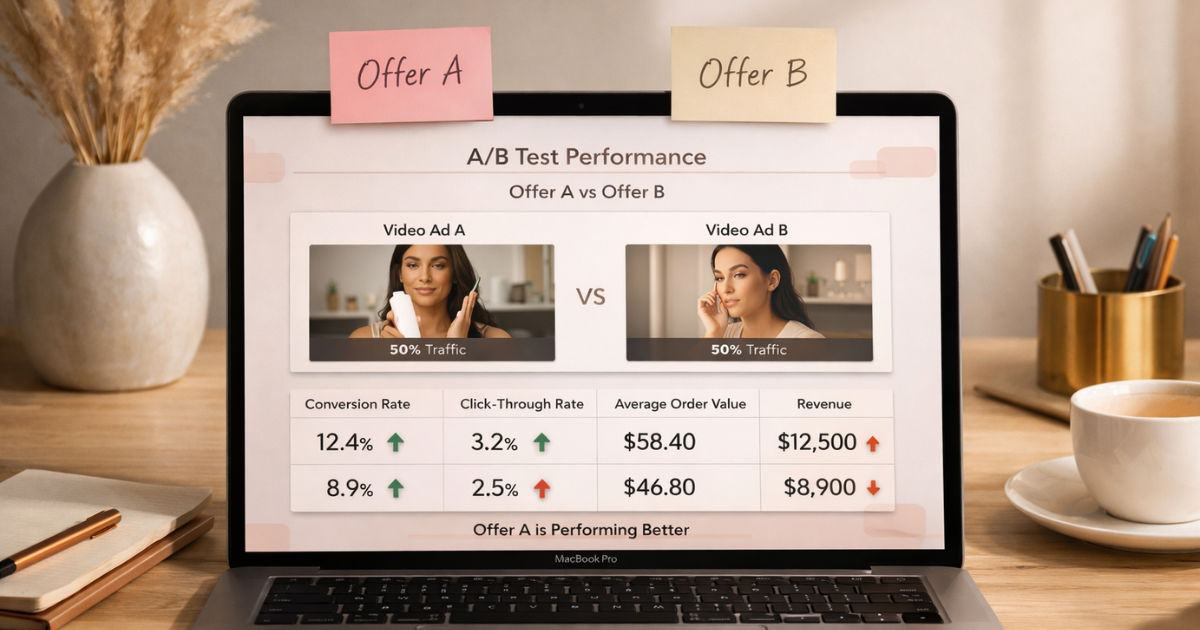
But neither matters if you do not test your offers.
An offer testing framework is what transforms insight into revenue. For growing brands, especially in regulated industries, this is where authority becomes measurable growth.
Here is how to structure it correctly.
Why Offers Fail Even When Content Is Strong
Many short-form videos generate:
- Views
- Likes
- Saves
But not conversions.
The issue is rarely the format. It is usually:
- The offer positioning
- The CTA clarity
- The risk reversal
- The mismatch between objection and ask
You may have addressed the audience’s concern but failed to present a compelling next step.
Testing fixes that.
Step 1: Define Your Core Objection Theme
Before testing offers, return to your insights.
What is the dominant friction?
- Price sensitivity
- Safety concerns
- Compliance questions
- Performance doubts
- Ease-of-use hesitation
Your offer should directly reduce that friction.
Example:
If price is the dominant objection, testing different discount percentages may not be enough. You may need:
- Installment framing
- ROI explanation
- Risk-free trial
- Guarantee positioning
Step 2: Structure a Simple Offer Testing Framework
Avoid complex multivariate testing in short-form.
Use controlled, simple experiments:
Test One Variable at a Time
- Offer type
- CTA phrasing
- Risk reversal
- Urgency framing
Keep:
- Hook constant
- Format constant
- Target audience constant
Change only the variable you are testing.
Example Offer Variations
Version A:
“Get 10 percent off today.”
Version B:
“Try it risk-free for 30 days.”
Version C:
“See results in 7 days or your money back.”
Each speaks to different psychological drivers:
- Savings
- Safety
- Speed
Step 3: Understand CTA Benchmarks by Industry
CTA performance varies significantly by industry.
In regulated categories:
- Education-first CTAs often outperform aggressive purchase CTAs.
- “Learn more” may convert better than “Buy now.”
- “See how it works” may reduce compliance friction.
In higher-consideration industries, soft CTAs frequently outperform hard sell CTAs because trust precedes action.
Instead of guessing, monitor:
- Click-through rate
- Comment intent
- Save rate
- Conversion rate
- Cost per action
Look for directional trends rather than absolute numbers.
Step 4: Match CTA to Buying Stage
Different objections signal different stages.
Awareness Stage:
CTA examples:
- “Save this”
- “Follow for more”
- “Learn how this works”
Consideration Stage:
CTA examples:
- “See pricing breakdown”
- “Compare options here”
- “Watch the full demo”
Decision Stage:
CTA examples:
- “Start your trial”
- “Book your consultation”
- “Order today”
If your CTA does not match buying stage, performance will stall.
Step 5: Document and Iterate
Testing is only valuable if you log outcomes.
For each test, track:
- Objection theme
- Offer angle
- CTA phrasing
- Platform
- Performance metrics
After 4–6 tests, patterns emerge.
This is where authority compounds.
Why This Is Critical for Regulated Industries
In regulated spaces:
- Claims are restricted
- Language must be compliant
- Risk perception is higher
Offer testing allows you to:
- Reduce friction without exaggeration
- Improve clarity without violating guidelines
- Find compliant but persuasive framing
Testing protects you from overreliance on trend-driven tactics that may not fit your compliance environment.
From Insight to Execution
When you combine:
- Social listening
- Competitor teardown
- Structured offer testing
You move from reactive content to controlled experimentation.
This is how growing brands build predictable growth.
To see how structured insights translate into executed video strategies, explore the Vizeel portfolio here:
https://www.vizeel.com/portfolio
Frequently Asked Questions
What is an offer testing framework?
An offer testing framework is a structured process for experimenting with different offers, CTA variations, and risk reversals to determine which version converts best.
How many variations should growing brands test?
Start with two to three variations per theme. Avoid testing too many variables at once to maintain clarity.
What are CTA benchmarks by industry?
CTA benchmarks refer to common performance patterns across industries. For example, education-focused CTAs often perform better in regulated industries where trust and clarity are critical.
How long should I run an offer test?
Run each variation long enough to collect meaningful data. Small brands may need several weeks, depending on traffic volume.
Key Takeaways
Insights tell you what your audience cares about.
Competitor teardown shows you what the market is doing.
Offer testing reveals what actually converts.
Authority is built when you combine all three.